
A High Priest Who Finally Sits Down: Why the New Covenant Changes Everything
A study through Hebrews 7-8 from Pastor Dave, Moses Lake Bible Church
Imagine trading in a horse-drawn buckboard wagon — the kind Pa Ingalls drove on Little House on the Prairie — for a brand-new pickup with 500 horsepower, a roof, air conditioning, and a smooth ride down the highway. That's not a bad picture of what the book of Hebrews is trying to tell us about the difference between the old covenant and the new covenant. The old wasn't a mistake. It was God's plan for a time. But the new is, in the words of Hebrews, infinitely better.
That's the heartbeat of this teaching: stop clinging to the old, and rest fully in what Jesus has already finished.
Melchizedek: A Preview of Something Greater
Hebrews 7 introduces a strange figure named Melchizedek, who appears only twice in the entire Old Testament, yet the author of Hebrews argues he's greater than father Abraham himself. To Jewish readers, that claim would have sounded almost scandalous. But the point isn't that Melchizedek was some divine being or a secret appearance of Jesus. He was a type — a foreshadowing — of Christ, for three key reasons.
First, he was both king and priest of "the Most High God," a combination almost unheard of in the ancient world, where kings and priests were kept separate. Second, he blessed Abraham after battle, and in Scripture the greater always blesses the lesser. That single detail carries enormous weight: the old covenant law could only condemn and expose sin, while a true blessing does something the law never could — it restores. Third, Scripture never records Melchizedek's birth or death. His story simply has no beginning and no end recorded, which mirrors the enduring, permanent nature of Christ's priesthood and the new covenant he inaugurates.
Put together, these three pictures build toward one central claim: Jesus is the perfectly sufficient priest and king, superior to the entire Levitical priesthood, and his sacrifice is full, final, and complete.
When Did the New Covenant Actually Begin?
Here's a question worth sitting with: when did the new covenant go into effect? Not at Jesus's birth. Not even at his resurrection. It began the moment the temple veil tore — the instant Jesus said, "It is finished." The resurrection wasn't what completed the work of atonement; it was God's proof to a "stiff-necked" people that the sacrifice had been accepted. The debt was paid at the cross.
Paul had already made this case in Romans, written roughly twelve years before Hebrews: "There is therefore now no condemnation for those who are in Christ Jesus... For God has done what the law, weakened by the flesh, could not do" (Romans 8:1–4). The law exposes sin and condemns. The Spirit, under the new covenant, restores and gives life. Same conclusion, different vocabulary — because the gospel and the new covenant are really one and the same truth.
He Sat Down — And That Changes Everything
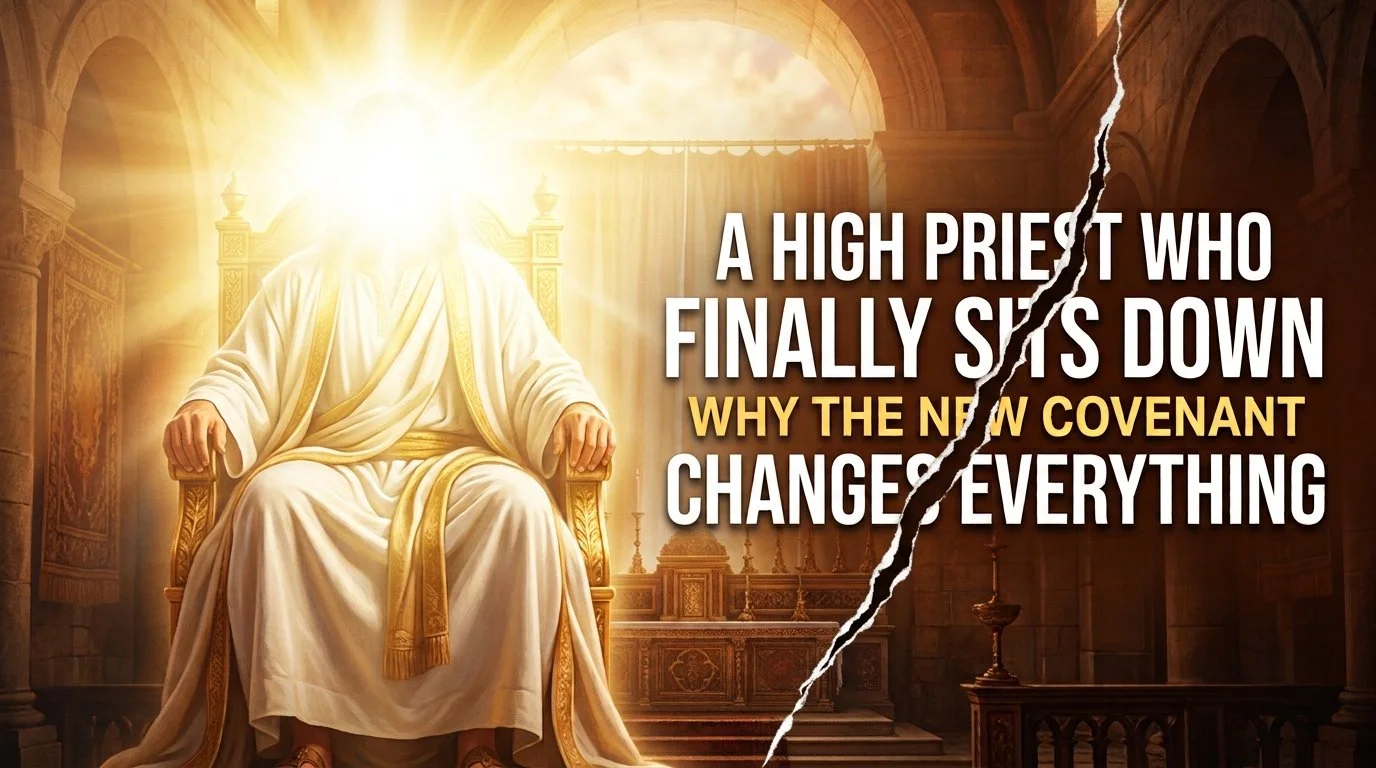
Hebrews 8 opens with a simple but staggering image: Jesus is "seated at the right hand of the throne of majesty in heaven." Under the old covenant, the Levitical priests never sat down. There wasn't even a chair in the tabernacle — the only "seat" was the mercy seat in the Holy of Holies, and no priest dared sit there. That absence of furniture wasn't an accident; it was symbolic. The priests' work was never finished. As Hebrews 10:11 puts it, every priest stood daily, "offering repeatedly the same sacrifices, which can never take away sins."
Jesus, by contrast, offered one sacrifice and sat down. The work was done. He had accomplished in a single act what centuries of priests, offerings, and rituals never could: full reconciliation between God and humanity.
There's a striking legal picture behind this image, too. In the Jewish Sanhedrin, the presiding judge had two scribes — one on his left recording condemnations, and one on his right recording acquittals. When Hebrews says Jesus sits at God's right hand, it's picturing him as the one whose record is permanently "not guilty." As John 3:17 says, God did not send his Son to condemn the world, but to save it.
Yet Jesus doesn't only sit — he also stands. In Acts 7:55, as Stephen is being stoned, he "gazed into heaven and saw the glory of God, and Jesus standing at the right hand of God." Which is it — does he sit or stand? Both. With regard to the finished work of redemption, he is seated; the price is paid, nothing remains to be added. But when one of his own is in trouble, he stands to advocate, actively interceding for us in real time. Both pictures are true at once: total rest in a finished work, and constant, active care for his people.
The Constant Temptation to Go Back
Here's the uncomfortable part of the message: almost nobody sitting in a modern church thinks they need to sacrifice a goat. But the instinct behind the old covenant — the desire for a human mediator, a ritual, a tangible act that puts a little control back in our hands — shows up everywhere throughout church history, and often in our own hearts.
Liturgical traditions that insert a priest between believers and God are one obvious example. But the temptation is broader and subtler than any one tradition. It shows up whenever we quietly believe our own effort, discipline, or "good enough" behavior is part of what makes us right with God. Any time we credit ourselves for our obedience, or feel we need to add something to grace, we're slipping back toward an obsolete system — one that could only expose sin, never remove it.
The old covenant was external, largely obedience driven by fear or obligation. The new covenant, made possible by the Holy Spirit living in believers, is internal. God's laws are written on the heart, not just handed down on tablets. Obedience is meant to flow from adoring love and gratitude, not duty or performance.
The Better Promise Behind the New Covenant
Hebrews 8 quotes Jeremiah 31, where God promises a new covenant "not like the covenant I made with their fathers... for they did not continue in my covenant." That's a critical detail: the old covenant failed because people broke it, not because God's design was flawed. Every covenant depends on promises, and the old covenant depended partly on human faithfulness — which history shows was never sustainable.
The new covenant is different because it rests entirely on God's promise, not ours. Jesus functions as the mediator, and a mediator's job is to represent both sides in a dispute. Only Jesus can do this, because only he is fully God and fully human. No priest, no religious system, no personal effort can stand in that gap. As Jesus says in John 14:6, "I am the way, and the truth, and the life. No one comes to the Father except through me."
This raises a natural question: what about believers who lived before Christ? Were they simply out of luck? The answer is no — salvation has always come by grace through faith, and God has always known the heart. In the Old Testament, genuine faith in God expressed itself through obedience to the law, not the other way around. That principle hasn't changed; only our understanding of how fully it was accomplished in Christ has been made clear.
A Simple, Honest Heart Check
One of the most practical takeaways from this teaching is a call to routine self-examination. It's easy to go years without checking whether your relationship with God has quietly shifted from love to habit, from thanksgiving to routine, or from grace to self-reliance. A simple prayer can reset that: Lord, show me where my true motivation is. Reveal anything that's coming between us.
That question isn't meant to produce guilt, but freedom — a reminder that nothing needs to be added to what Jesus has already finished.
The Takeaway: Rest, Don't Strive
The message running through all of Hebrews 7–8 comes down to a single, freeing idea: the old covenant is obsolete, and the new covenant is not a partial upgrade — it's a complete transformation. Jesus's sacrifice was sufficient once, for all. He sits because it is finished; he stands because he still cares.
The invitation, then as now, is simple: stop trying to add to grace. Come to Jesus as your only mediator, rest in what he has already accomplished, and let obedience flow from love rather than fear. As the teaching puts it, this is "the most amazing golden ticket" — one we may not fully appreciate until we see him face to face.
This post is adapted from a Sunday message at Moses Lake Bible Church, Moses Lake, Washington. Join us in person Sundays at 9:00 a.m. or 11:00 a.m., or watch our livestream at 11:00 a.m. Learn more at mlbiblechurch.org.
